

The LRM Studio is an artist-led studio, founded in London and shaped by life in Whitstable, Kent.
Discover original art, coastal home fragrance, and lifestyle pieces designed by British artist Lauren Rogers-Martin.

coastal décor
How to Create a Coastal Home Without Living by the Sea
“
The most beautiful homes aren't the most expensive. They're the ones that tell the most honest stories.
— Lauren Rogers-Martin, Founder
You don't need to be five minutes from the water to have a home that feels like it. The coastal aesthetic — at its best — isn't about anchors and rope and seagulls on mugs. It's a quality of light, a restraint of palette, a sense of calm that arrives when you walk through the door. All of that is achievable anywhere.
Here's how we'd approach it.
Start with the Palette
The coastal palette isn't blue and white. That's a shortcut — recognisable but ultimately a bit of a dead end. The colours of the actual coast are more interesting: the grey-green of the sea before a storm, the warm chalky white of beach huts, the particular sandy taupe of shingle in summer, the dusty blue of sea holly and sea kale.
Build a room around two or three of these tones and you'll get something that feels genuinely coastal rather than nautically themed. Layer in texture — linen, natural wood, unglazed ceramics — and the effect deepens.
Bring in Natural Materials
Coast is essentially nature, and the homes that evoke it best are full of natural materials. Bare wood floors or boards painted in a quiet stone colour. Linen curtains that move in a breeze. Wicker, rush, or seagrass. Stone or slate surfaces. These are the textures of a life lived close to the outdoors, and they bring that feeling inside with them.
Avoid anything that feels synthetic or too finished. Coastal interiors tend towards the honest and the slightly worn — furniture that looks like it might have been in the family for a while, objects that have a history.
Choose Art That Does the Work
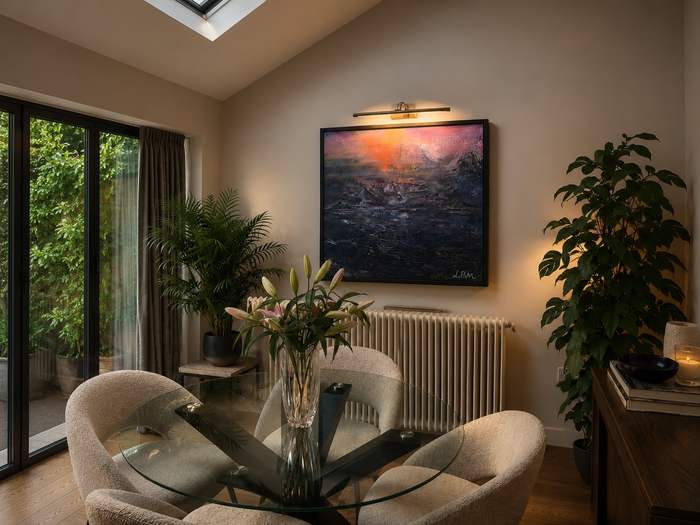
This is where a lot of coastal rooms either come alive or fall flat. Generic prints of lighthouses and shells add very little. What works instead is art that actually captures light and atmosphere — an original painting with a real feel for sky and water, or a fine art print that has the depth and tone of something made by hand.
An original seascape or coastal landscape by a working artist brings something genuine into a room. You're not buying a symbol of the coast — you're bringing in a piece of it. The right painting does more than ten carefully chosen accessories.
Edit, Don't Accumulate
Coastal interiors are calm by nature. Resist the urge to fill every surface. A few considered objects — a piece of sea glass, a good candle, a beautiful ceramic — will do more than a shelf crowded with things. Leave room for air and light. The restraint is part of what makes the space feel right.
Light
Nothing defines a coastal room more than light, and while you can't conjure sea light in a city flat, you can make the most of what you have. Light-coloured walls bounce what light there is. Mirrors help. Curtains that pull fully clear of the window make a significant difference. And in the evenings, warm candlelight — rather than cold overhead lighting — creates something that feels genuinely restorative.
One Room at a Time
You don't need to restyle a whole house. Start with one room — the living room, or a bedroom — and get it right. Once you have one space that genuinely makes you feel something when you walk in, you'll know what to carry through to the rest.
Explore original paintings, fine art prints, and home objects from LRM Studio — all made with coastal interiors in mind.
From Lauren
When I first moved to Whitstable, I thought I was moving because of the sea.
Looking back, I don't think it was the sea at all.
I think I was searching for a slower way to live.
A home where beautiful things weren't saved for guests.
Where candles were lit on ordinary Tuesdays.
Where artwork wasn't bought to impress people — it simply made me smile every morning.
That's what Living Beautifully means to me.
Lauren x
