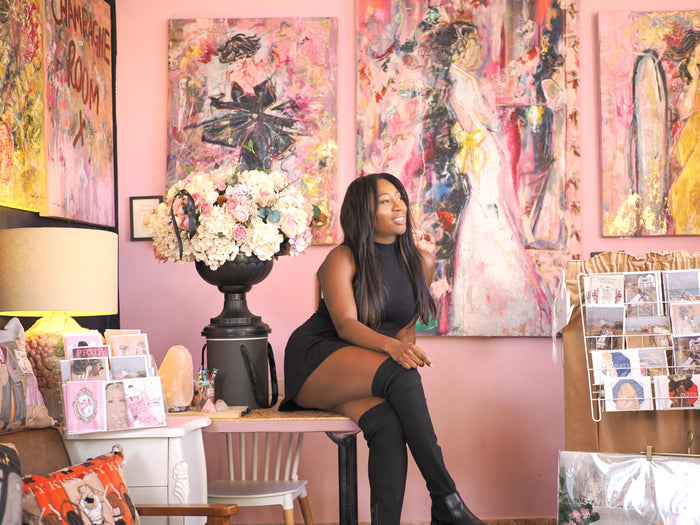
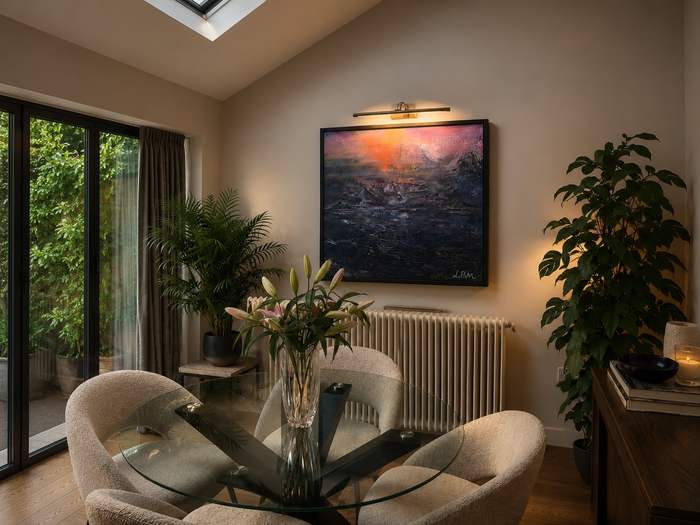


The LRM Studio is an artist-led studio, founded in London and shaped by life in Whitstable, Kent.
Discover original art, coastal home fragrance, and lifestyle pieces designed by British artist Lauren Rogers-Martin.

British artist
Colour by the Sea: How the Whitstable Coast Inspires Our Palette
“
The most beautiful homes aren't the most expensive. They're the ones that tell the most honest stories.
— Lauren Rogers-Martin, Founder
People often ask where the colours come from. The answer is always the same: look out the window.
Working in Whitstable means living inside a palette that changes with the season, the tide, the time of day, and the weather in a way that never fully becomes predictable. It sounds romantic, and it is — but it's also extremely useful. The coast is an education in colour that you couldn't design if you tried.
The Colours of Low Tide
At low tide, the palette turns warm. The shingle reveals itself in shades that veer between sandy ochre, warm grey, and a kind of damp sienna that only appears when the stones are wet and the light is right. The sea at low tide is paler — a thin washed-out blue-green at the horizon, almost colourless near the shore. And the sky, particularly in the morning, does things with pink and amber that you rarely see inland.
These are the colours that find their way most consistently into the studio work: the warmth, the pale-to-dark gradations, the way a single scene holds ten different tones at once.
Winter Light
Winter on the Kent coast is misunderstood. The tourist town empties out, and what's left is the coast itself, stripped back and extraordinary. The light in November and December has a clarity that summer can't match — lower in the sky, casting long shadows, making colours more saturated rather than bleached. Grey water against grey sky sounds monotone until you're actually there, and then you realise how many different greys there are.
Some of the most interesting work comes from winter walks. The restraint of the palette forces a precision that summer, with all its abundance and warmth, doesn't always demand.
Summer and the Bleaching Effect
Summer reverses everything. The light comes in strong and high, and it bleaches — the shingle goes pale and almost silver, the sea becomes that particular flat blue of a hot English day, the beach huts glow white and candy-coloured. There's a joyfulness to the summer palette that's worth capturing even if it's not where the most complex work tends to live.
The challenge in summer is finding the shadow. Working early in the morning or in the late afternoon, when the light is angled and the colours deepen again, produces something closer to what the coast actually feels like to be in, versus the postcard version of it.
How This Shows Up in the Work
Every painting in the LRM Studio collection carries some trace of this landscape — in the palette choices, the tonal range, the way light is handled. Even work that isn't obviously a seascape tends to carry something coastal about it: a particular restraint, a preference for the slightly muted over the saturated, a quality of air.
That's what living and working in a place does to you, eventually. The place gets into the work. We think that's something worth seeking out when you're collecting art — not just an image, but evidence of an actual somewhere.
Explore original paintings and fine art prints from The LRM Studio — all made in Whitstable, by the sea.
From Lauren
When I first moved to Whitstable, I thought I was moving because of the sea.
Looking back, I don't think it was the sea at all.
I think I was searching for a slower way to live.
A home where beautiful things weren't saved for guests.
Where candles were lit on ordinary Tuesdays.
Where artwork wasn't bought to impress people — it simply made me smile every morning.
That's what Living Beautifully means to me.
Lauren x
